
Oct 13, 2026Buying Guides
Is the PVC Data Strip Industry Declining? What Buyers Should Know
Fewer Chinese factories are quoting data strips than five years ago. Here is why that is happening, what it means for your supply, and how to choose a supplier who will still be there next year.
If you have sourced shelf-edge label holders for a few years, you may have noticed something: the number of factories quoting your inquiry has gone down. Some suppliers who were reliable in 2020 no longer reply. Others have dropped data strips from their catalog entirely and moved to different plastic profiles.
This is not a temporary dip. The PVC data strip industry is going through a real consolidation, and it changes how buyers should think about sourcing.
Here is what is actually happening — and what it means when you place your next order.
The short answer
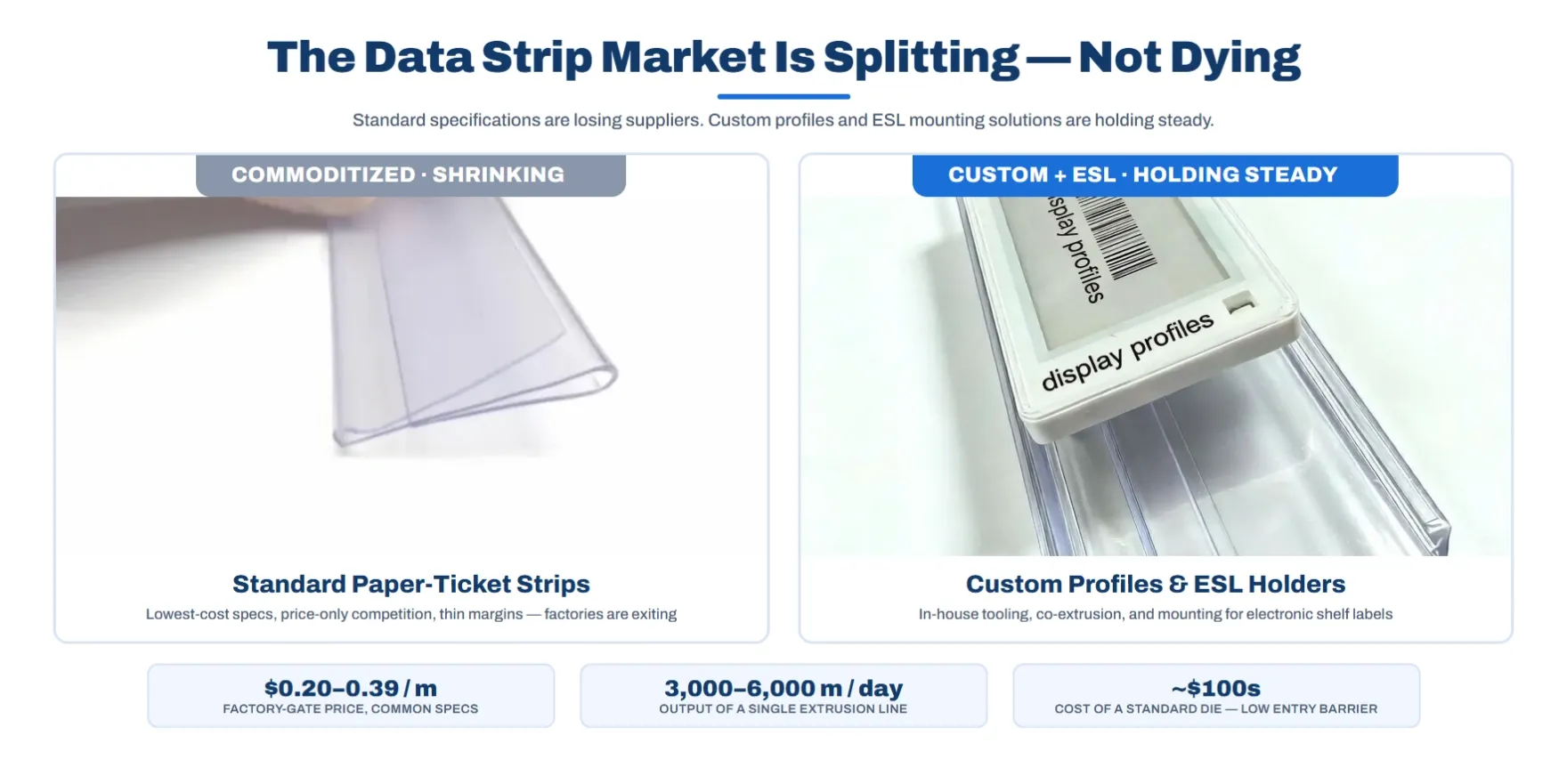
Data strips have not disappeared, and they are not going to. But the low-end, standard-specification segment is shrinking fast, while the custom and technical segment is holding up.
Factories are not leaving because demand vanished. They are leaving because the standard product stopped being profitable at the prices buyers expect, while costs kept rising. What remains is a smaller group of suppliers who compete on capability rather than on price alone.
Reason 1: The margins are simply too thin
A data strip is an extruded PVC profile. It is sold by the meter, and the material cost is mostly PVC resin. In practice, factory-gate prices for common specifications sit in the range of US$0.20 to US$0.39 per meter, often quoted on a tiered scale where the price drops as volume rises.
Now consider the output side. A single extrusion line typically produces in the range of 3,000 to 6,000 meters per day. Even if every meter sells, that is a modest daily production value — and from it you must subtract PVC resin, electricity for 24-hour operation, labor across shifts, scrap and rework, and packaging.
What is left is a single-digit margin in many cases. That margin was workable when labor was cheap, environmental enforcement was lighter, and PVC prices were stable. All three of those conditions have reversed over the past decade:
- Labor: extrusion runs around the clock, and shift wages have risen sharply.
- Environment: PVC extrusion involves plasticizers and edge trim waste, which brings compliance costs and periodic shutdowns for smaller operators.
- Raw material: PVC resin prices move, but the price you quoted your buyer is often fixed for the season.
When a raw material increase eats the entire margin, the rational move for a small factory is to stop quoting.
Reason 2: The barrier to entry is almost zero
The core asset in this business is the extrusion die — and a die for a standard data strip profile costs only a few hundred US dollars and can be made in roughly one to two weeks.
That has two consequences. First, any small workshop can reproduce the popular specifications, so the market is crowded. Second, buyers can always find another supplier, which means the only lever is price. An inquiry for a standard 1000 mm strip with a common label height can attract dozens of comparable quotes.
The result is a race that nobody wins. Factories that cannot differentiate exit rather than keep bidding.
Reason 3: The buyer holds all the negotiating power
The end user is a supermarket, but the actual purchaser is usually a shelf manufacturer, a shopfitting company, or a retail equipment distributor. For those buyers, a data strip is a small accessory within a larger fixture order.
That makes switching suppliers almost painless. It also means the typical asks are demanding: aggressive pricing, vendor-managed stock, and 60- to 90-day payment terms. A factory with no brand and no unique capability has no counterweight, so it absorbs the pressure until it can no longer.
Reason 4: Demand is being structurally reduced
This is the most important factor, and the one buyers should watch most closely.
Electronic shelf labels (ESL) are replacing paper price strips. Chains across Europe, Japan, and major cities in China have been converting to digital price tags at scale. One electronic label replaces the paper ticket a data strip was designed to hold. This is not a business cycle — it is a change in how stores display prices.
At the same time, stores are digitizing shelf communication more broadly, with screens and e-ink displays taking over some of what printed shelf signage used to do.
So the market for a basic strip that holds a paper ticket is genuinely smaller than it was. That is a structural shift, not a temporary lull.
Reason 5: Export conditions got harder
For export-focused factories, several costs have moved in the wrong direction at once:
- Tariffs and trade friction on Chinese PVC products in some markets directly reduce already thin margins.
- Compliance such as REACH, RoHS, and third-party testing costs money and time — affordable for larger factories, painful for small ones.
- Competition from other regions: extrusion suppliers in Vietnam, India, and Turkey have taken a share of the mid- and low-end orders.
What this means for buyers
The consolidation has an upside if you read it correctly. Factories are not leaving because the product is obsolete — they are leaving because the undifferentiated version of it is unprofitable. That leaves a market where the surviving suppliers are, on average, more capable than the ones that exited.
Three practical implications:
Your supplier base may shrink faster than you expect
If you currently rely on a single low-cost factory for a standard profile, it is worth qualifying a second source now rather than after your first one stops replying. Ask directly whether data strips are still a core product line or a side business.
Custom work is where supply is stable
Factories that can design and cut their own tooling, run co-extrusion, and produce non-standard profiles have a reason to stay in the business — those orders do not reduce to a price comparison.
Plan for the ESL transition, not against it
If your retail customers are moving to electronic labels, the accessory demand shifts from paper-ticket holders to mounting solutions: ESL holders that keep digital tags secure, correctly angled, and protected during restocking. Buyers who source both from one supplier reduce their vendor count and their integration risk.
How to choose a supplier in a consolidating market
When you evaluate a data strip supplier in this environment, the useful questions are not only about price. Ask:
- Is data strip extrusion a core business or a leftover? A supplier with in-house tooling and dedicated lines will still be producing when the market thins out.
- Can they make the tooling themselves? In-house mold design and manufacturing means custom sizes, colors, and shapes are realistic rather than aspirational — and it shortens sampling time.
- Do they run co-extrusion? Two- or three-extruder co-extrusion supports multi-material and multi-color profiles that standard single-extrusion lines cannot produce.
- What is the real sampling and lead time? Ask for specific numbers in days, and test them on a small order before committing to a program.
- Can they supply ESL holders alongside data strips? Sourcing both from one factory simplifies your transition as your retail customers digitize.
- What happens to your tooling if you leave? Confirm in writing who owns the mold and whether it can be transferred.
FAQ
Are data strips being phased out completely?No. They are still standard on countless shelves, and they remain the lowest-cost way to display price, barcode, and product information on a shelf edge. What is shrinking is the market for the most basic, undifferentiated specification.Should I stop sourcing data strips from China?Not necessarily. China still has the deepest extrusion capacity and tooling expertise for this product. The practical change is which Chinese factories make sense — the ones with tooling capability and a stable product line, rather than the cheapest quote.How long will my current supplier last?There is no way to know for certain, but there are signals: are they still investing in new molds, do they quote custom work, do they answer technical questions in detail? A supplier that only quotes standard specifications at the lowest price is the most exposed.Will ESL replace data strips in my market?That depends on your market and your customers. High-labor-cost markets with large chains typically adopt ESL earlier. In many regions, paper strips and electronic labels will coexist for years — and during that period, retailers need mounting solutions for both.Does a consolidating market mean higher prices?Not automatically. It means the floor on price may rise as the least efficient producers leave, while capable suppliers compete on specification, customization, and service rather than on price alone.
The bottom line
The data strip industry is not dying. It is separating into two markets: a commoditized segment that is shrinking because it cannot be profitable, and a technical segment built around custom profiles, tooling, and electronic shelf label integration that is holding steady.
For buyers, the takeaway is straightforward: stop choosing a supplier only on unit price, and start choosing one on capability. The supplier who can make your custom profile and mount your electronic labels is the one who will still be answering your emails in three years.
Need a custom data strip profileIf you have sourced shelf-edge label holders for a few years, you may have noticed something: the number of factories quoting your inquiry has gone down. Some suppliers who were reliable in 2020 no longer reply. Others have dropped data strips from their catalog entirely and moved to different plastic profiles.
This is not a temporary dip. The PVC data strip industry is going through a real consolidation, and it changes how buyers should think about sourcing.
Here is what is actually happening — and what it means when you place your next order.
The short answer
Data strips have not disappeared, and they are not going to. But the low-end, standard-specification segment is shrinking fast, while the custom and technical segment is holding up.
Factories are not leaving because demand vanished. They are leaving because the standard product stopped being profitable at the prices buyers expect, while costs kept rising. What remains is a smaller group of suppliers who compete on capability rather than on price alone.
Reason 1: The margins are simply too thin
A data strip is an extruded PVC profile. It is sold by the meter, and the material cost is mostly PVC resin. In practice, factory-gate prices for common specifications sit in the range of US$0.20 to US$0.39 per meter, often quoted on a tiered scale where the price drops as volume rises.
Now consider the output side. A single extrusion line typically produces in the range of 3,000 to 6,000 meters per day. Even if every meter sells, that is a modest daily production value — and from it you must subtract PVC resin, electricity for 24-hour operation, labor across shifts, scrap and rework, and packaging.
What is left is a single-digit margin in many cases. That margin was workable when labor was cheap, environmental enforcement was lighter, and PVC prices were stable. All three of those conditions have reversed over the past decade:
- Labor: extrusion runs around the clock, and shift wages have risen sharply.
- Environment: PVC extrusion involves plasticizers and edge trim waste, which brings compliance costs and periodic shutdowns for smaller operators.
- Raw material: PVC resin prices move, but the price you quoted your buyer is often fixed for the season.
When a raw material increase eats the entire margin, the rational move for a small factory is to stop quoting.
Reason 2: The barrier to entry is almost zero
The core asset in this business is the extrusion die — and a die for a standard data strip profile costs only a few hundred US dollars and can be made in roughly one to two weeks.
That has two consequences. First, any small workshop can reproduce the popular specifications, so the market is crowded. Second, buyers can always find another supplier, which means the only lever is price. An inquiry for a standard 1000 mm strip with a common label height can attract dozens of comparable quotes.
The result is a race that nobody wins. Factories that cannot differentiate exit rather than keep bidding.
Reason 3: The buyer holds all the negotiating power
The end user is a supermarket, but the actual purchaser is usually a shelf manufacturer, a shopfitting company, or a retail equipment distributor. For those buyers, a data strip is a small accessory within a larger fixture order.
That makes switching suppliers almost painless. It also means the typical asks are demanding: aggressive pricing, vendor-managed stock, and 60- to 90-day payment terms. A factory with no brand and no unique capability has no counterweight, so it absorbs the pressure until it can no longer.
Reason 4: Demand is being structurally reduced
This is the most important factor, and the one buyers should watch most closely.
Electronic shelf labels (ESL) are replacing paper price strips. Chains across Europe, Japan, and major cities in China have been converting to digital price tags at scale. One electronic label replaces the paper ticket a data strip was designed to hold. This is not a business cycle — it is a change in how stores display prices.
At the same time, stores are digitizing shelf communication more broadly, with screens and e-ink displays taking over some of what printed shelf signage used to do.
So the market for a basic strip that holds a paper ticket is genuinely smaller than it was. That is a structural shift, not a temporary lull.
Reason 5: Export conditions got harder
For export-focused factories, several costs have moved in the wrong direction at once:
- Tariffs and trade friction on Chinese PVC products in some markets directly reduce already thin margins.
- Compliance such as REACH, RoHS, and third-party testing costs money and time — affordable for larger factories, painful for small ones.
- Competition from other regions: extrusion suppliers in Vietnam, India, and Turkey have taken a share of the mid- and low-end orders.
What this means for buyers
The consolidation has an upside if you read it correctly. Factories are not leaving because the product is obsolete — they are leaving because the undifferentiated version of it is unprofitable. That leaves a market where the surviving suppliers are, on average, more capable than the ones that exited.
Three practical implications:
Your supplier base may shrink faster than you expect
If you currently rely on a single low-cost factory for a standard profile, it is worth qualifying a second source now rather than after your first one stops replying. Ask directly whether data strips are still a core product line or a side business.
Custom work is where supply is stable
Factories that can design and cut their own tooling, run co-extrusion, and produce non-standard profiles have a reason to stay in the business — those orders do not reduce to a price comparison.
Plan for the ESL transition, not against it
If your retail customers are moving to electronic labels, the accessory demand shifts from paper-ticket holders to mounting solutions: ESL holders that keep digital tags secure, correctly angled, and protected during restocking. Buyers who source both from one supplier reduce their vendor count and their integration risk.
How to choose a supplier in a consolidating market
When you evaluate a data strip supplier in this environment, the useful questions are not only about price. Ask:
- Is data strip extrusion a core business or a leftover? A supplier with in-house tooling and dedicated lines will still be producing when the market thins out.
- Can they make the tooling themselves? In-house mold design and manufacturing means custom sizes, colors, and shapes are realistic rather than aspirational — and it shortens sampling time.
- Do they run co-extrusion? Two- or three-extruder co-extrusion supports multi-material and multi-color profiles that standard single-extrusion lines cannot produce.
- What is the real sampling and lead time? Ask for specific numbers in days, and test them on a small order before committing to a program.
- Can they supply ESL holders alongside data strips? Sourcing both from one factory simplifies your transition as your retail customers digitize.
- What happens to your tooling if you leave? Confirm in writing who owns the mold and whether it can be transferred.
FAQ
Are data strips being phased out completely?No. They are still standard on countless shelves, and they remain the lowest-cost way to display price, barcode, and product information on a shelf edge. What is shrinking is the market for the most basic, undifferentiated specification.Should I stop sourcing data strips from China?Not necessarily. China still has the deepest extrusion capacity and tooling expertise for this product. The practical change is which Chinese factories make sense — the ones with tooling capability and a stable product line, rather than the cheapest quote.How long will my current supplier last?There is no way to know for certain, but there are signals: are they still investing in new molds, do they quote custom work, do they answer technical questions in detail? A supplier that only quotes standard specifications at the lowest price is the most exposed.Will ESL replace data strips in my market?That depends on your market and your customers. High-labor-cost markets with large chains typically adopt ESL earlier. In many regions, paper strips and electronic labels will coexist for years — and during that period, retailers need mounting solutions for both.Does a consolidating market mean higher prices?Not automatically. It means the floor on price may rise as the least efficient producers leave, while capable suppliers compete on specification, customization, and service rather than on price alone.
The bottom line
The data strip industry is not dying. It is separating into two markets: a commoditized segment that is shrinking because it cannot be profitable, and a technical segment built around custom profiles, tooling, and electronic shelf label integration that is holding steady.
For buyers, the takeaway is straightforward: stop choosing a supplier only on unit price, and start choosing one on capability. The supplier who can make your custom profile and mount your electronic labels is the one who will still be answering your emails in three years.